

 English
 中文简体
中文简体 русский
 Deutsch
Content
- 1 How to Weld Aluminum With Welding Wire
- 2 Aluminum Welding Wire for MIG Welding
- 3 Aluminum Welding Wire for TIG Welding
- 4 Aluminum Welding Wire vs. Aluminum Filler Rod
- 5 ER4043 vs. ER5356 Aluminum Welding Wire
- 6 4043 Aluminum Welding Wire Applications
- 7 5356 Aluminum Welding Wire Applications
- 8 How to Prevent Aluminum Welding Defects
- 9 Best Aluminum Welding Wire for MIG Welding
- 10 Aluminum Welding Problems and Solutions
How to Weld Aluminum With Welding Wire
Welding aluminum successfully comes down to controlling heat input and keeping the weld area free of contamination — both of which are more demanding than with steel because of aluminum's thermal conductivity and its persistent oxide layer. A basic workflow looks like this:
- Clean the base metal with a dedicated stainless steel brush and solvent to remove the oxide layer and any oil or dirt immediately before welding.
- Select the correct filler wire based on base alloy, using a 4xxx or 5xxx series wire as appropriate.
- Set amperage higher than for equivalent-thickness steel, since aluminum draws heat away from the weld pool quickly.
- Use a shorter arc length and consistent travel speed to maintain a stable weld pool and avoid porosity.
- Shield with 100% argon (or an argon-helium blend for thicker sections) to protect the molten pool from atmospheric contamination.
Aluminum Welding Wire for MIG Welding
For MIG (GMAW) welding, aluminum wire is supplied on spools and fed continuously through the gun, typically using spray transfer or pulsed spray transfer rather than short-circuit transfer, which tends to produce poor results on aluminum. A few MIG-specific considerations:
- Use a push technique (gun angled away from the weld pool, pushing forward) rather than a pull technique, for better shielding gas coverage and cleaner arc starts.
- Use a dedicated aluminum drive system — U-groove drive rollers and a Teflon or nylon-lined liner — since aluminum wire is soft and standard steel drive systems tend to deform or bird's-nest it.
- Keep the gun liner and contact tip clean — aluminum sheds fine particulate as it feeds, which builds up faster than steel wire residue.
Aluminum Welding Wire for TIG Welding
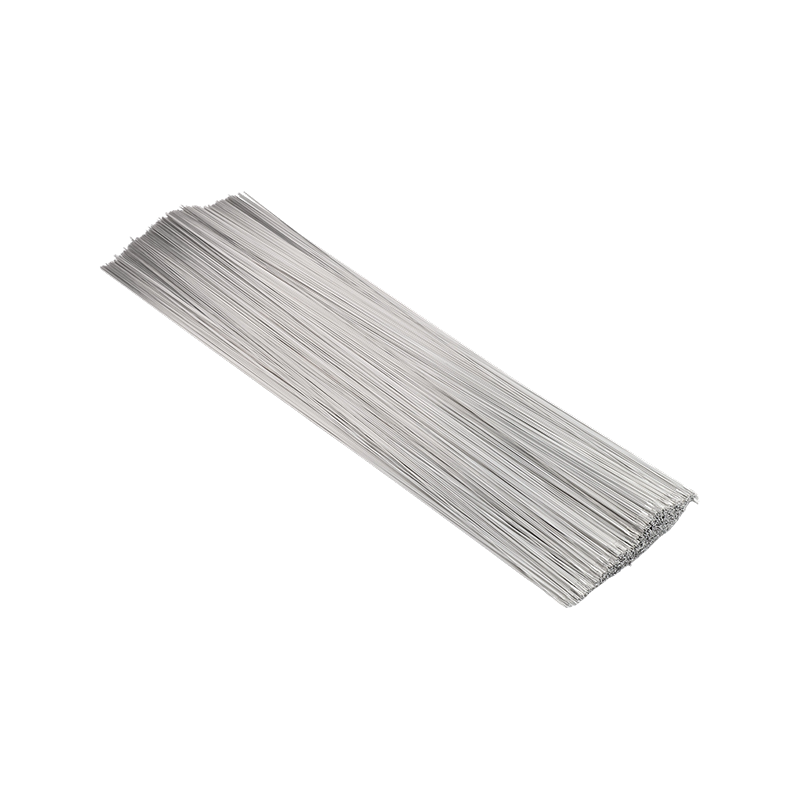
For TIG (GTAW) welding, aluminum filler is supplied as straight rods (not spooled) and fed manually into the weld pool. TIG welding of aluminum also requires AC (alternating current) rather than the DC typically used for steel, because the AC cycle's cleaning phase breaks down the oxide layer during welding. Key points for TIG:
- Match rod diameter to material thickness and amperage range — oversized rod chills the puddle, undersized rod overheats quickly.
- Keep the rod tip inside the gas shield at all times to prevent oxidation of the filler metal before it enters the weld pool.
- Use a balanced or slightly cleaning-biased AC waveform on inverter machines for a good compromise between oxide removal and penetration.
Aluminum Welding Wire vs. Aluminum Filler Rod
"Wire" and "rod" often get used interchangeably, but they refer to different physical forms of the same filler alloys, matched to different processes:
| Form | Process | Feed Method |
|---|---|---|
| Spooled wire | MIG (GMAW) | Continuous, machine-fed |
| Straight-cut rod | TIG (GTAW) | Manual, hand-fed |
The alloy selection rules (4xxx vs. 5xxx, etc.) apply equally to both forms — the choice between wire and rod comes down entirely to which welding process is being used, not a difference in the filler metal itself.
ER4043 vs. ER5356 Aluminum Welding Wire
These two are the most commonly stocked aluminum filler wires, and the choice between them is one of the most frequent questions in aluminum welding:
| Property | ER4043 | ER5356 |
|---|---|---|
| Alloy base | Aluminum-silicon | Aluminum-magnesium |
| Crack resistance | Excellent | Good |
| Tensile strength | Lower | Higher |
| Corrosion resistance (saltwater) | Fair | Good |
| Anodized finish match | Poor (grayish tint) | Better match |
4043 Aluminum Welding Wire Applications
ER4043 is generally the default choice for general-purpose aluminum fabrication, including:
- Welding cast aluminum components, where its higher silicon content reduces cracking risk in the heat-affected zone.
- Automotive and general fabrication work on 6xxx-series base alloys (a very common structural aluminum family).
- Applications where smooth arc characteristics and puddle control matter more than maximum tensile strength.
5356 Aluminum Welding Wire Applications
ER5356 is favored where strength and corrosion resistance take priority over ease of puddle control, including:
- Marine welding, where resistance to saltwater corrosion is a primary requirement.
- Structural fabrication on 5xxx-series base alloys, keeping filler and base metal chemistry compatible.
- Projects that will later be anodized, where color consistency between weld and base metal matters visually.
How to Prevent Aluminum Welding Defects
Most aluminum weld defects trace back to a handful of root causes, and most are preventable with consistent shop practice:
- Porosity — usually from hydrogen contamination (moisture, oil, or oxide on the base metal or wire). Prevent by cleaning immediately before welding and storing wire properly.
- Cracking — often from mismatched filler/base alloy chemistry or excessive heat input. Prevent by verifying alloy compatibility and controlling travel speed and amperage.
- Lack of fusion — commonly from insufficient heat input or too-fast travel speed, given how quickly aluminum conducts heat away from the weld zone.
- Burn-through — typically from excessive heat on thin sections. Prevent with proper amperage settings and appropriately sized filler wire for the material thickness.
Best Aluminum Welding Wire for MIG Welding
For most general MIG fabrication work, ER4043 in 0.035" diameter is a reliable default — it offers good arc stability, forgiving crack resistance, and works well across a range of aluminum base alloys. Step up to ER5356 when the project specifically calls for higher strength, marine-grade corrosion resistance, or when welding a 5xxx-series base alloy. When in doubt about base alloy compatibility, checking a filler metal compatibility chart from a wire manufacturer takes only a few minutes and avoids a costly rework.
Aluminum Welding Problems and Solutions
| Problem | Likely Cause | Solution |
|---|---|---|
| Bird's-nesting at the gun | Wrong drive rollers or excess feed tension | Use U-groove rollers, reduce tension, check liner condition |
| Porous, pitted welds | Contaminated base metal or wire | Clean thoroughly before welding, store wire sealed and dry |
| Weld cracking on cooling | Mismatched filler/base alloy | Verify alloy compatibility before welding |
| Burn-through on thin material | Excess heat input | Lower amperage, increase travel speed, use smaller wire |