

 English
 中文简体
中文简体 русский
 Deutsch
Content
- 1 Why Alloy Composition Defines Aluminum Wire Performance
- 2 Strengthening Mechanisms: Solid Solution, Precipitation, and Work Hardening
- 3 High-Strength Aluminum Alloy Wire: Grade Profiles and Where Each Is Specified
- 4 Temper Selection and Its Effect on Downstream Processability
- 5 Qualification Standards and Documentation Requirements for Industrial Procurement
Why Alloy Composition Defines Aluminum Wire Performance
Unalloyed aluminum — the 1xxx series — is an excellent electrical conductor but a structurally limited material. Its tensile strength in the annealed condition sits around 60–90 MPa, and even in fully work-hardened temper rarely exceeds 185 MPa. For a broad class of industrial, automotive, aerospace, and energy infrastructure applications, this is insufficient. Aluminum alloy wire addresses this gap by introducing controlled additions of elements — magnesium, silicon, copper, zinc, manganese, zirconium — that interact with the aluminum lattice through distinct strengthening mechanisms, pushing tensile strength into ranges that were previously the exclusive domain of steel or copper alloys at significantly higher weight and cost.
The practical consequence is a material family with a wider property envelope than any single-composition wire can deliver. Aluminum alloy wire today spans tensile strengths from 150 MPa to over 550 MPa, conductivity values from 28% to 59% IACS, and formability ranges from highly ductile annealed strip to near-zero elongation high-strength tempers — all within the same base metal system. Understanding which portion of this envelope a given application actually requires is the starting point for any rational wire specification exercise, and it begins with understanding what each alloy addition does at the microstructural level.
Strengthening Mechanisms: Solid Solution, Precipitation, and Work Hardening
Three distinct metallurgical mechanisms contribute to strength in aluminum alloy wire, and most commercial alloys exploit more than one simultaneously. Solid solution strengthening occurs when alloying atoms dissolve into the aluminum lattice and create local lattice distortions that impede dislocation movement. Magnesium is the most effective solid solution strengthener in aluminum — each 1 wt% Mg addition raises yield strength by approximately 30 MPa while reducing conductivity by around 6% IACS. This is the dominant mechanism in non-heat-treatable 5xxx alloys, where strength is set at casting and cannot be further increased by heat treatment after forming.
Precipitation hardening — the mechanism exploited by heat-treatable 2xxx, 6xxx, and 7xxx alloys — produces significantly greater strength increments. After solution heat treatment and quenching, controlled aging causes nanoscale intermetallic precipitates to form coherently within grains. These precipitates create obstacles that dislocations must cut through or bypass, requiring substantially more stress to sustain plastic deformation. The 6061-T6 alloy achieves 310 MPa tensile strength through this mechanism, compared to roughly 125 MPa in the O (annealed) temper — a 2.5× increase from heat treatment alone, with no change in composition. Work hardening through cold drawing adds a further increment, and in non-heat-treatable alloys it is the primary strengthening tool available after casting, which is why 1350-H19 conductor wire (heavily cold-worked) achieves 185 MPa despite its near-pure composition.
Zirconium additions — used in small quantities (0.1–0.3 wt%) in several elevated-temperature alloys — operate through a fourth mechanism: dispersoid formation. Al₃Zr particles pin grain boundaries and inhibit recrystallization at elevated service temperatures, making Zr-bearing alloys the preferred choice for overhead conductors that must maintain strength and resist creep at continuous operating temperatures above 150°C.
High-Strength Aluminum Alloy Wire: Grade Profiles and Where Each Is Specified
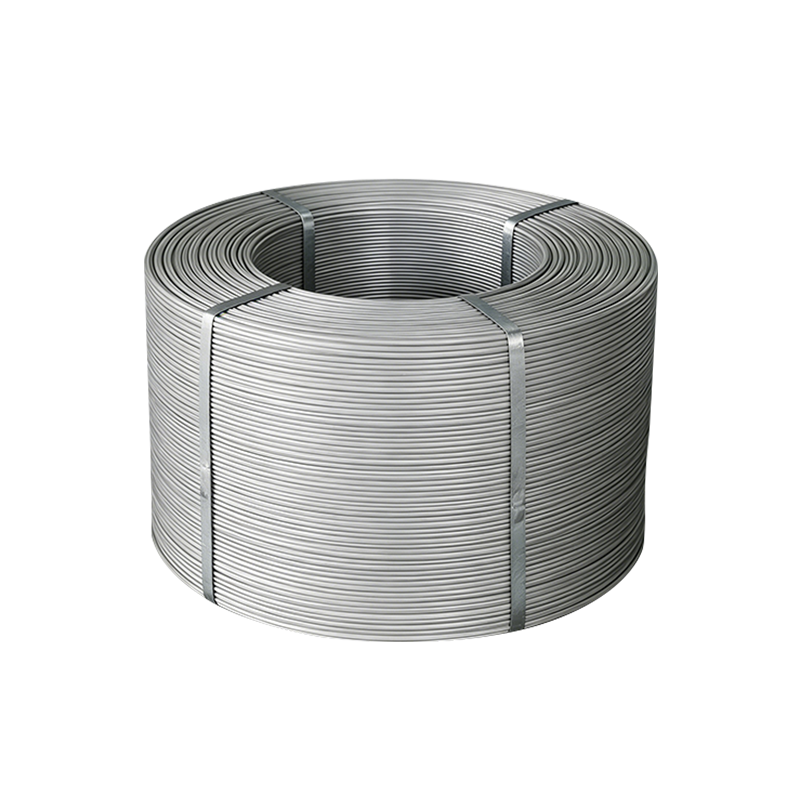
High-strength aluminum alloy wire is generally understood to begin at tensile strengths above 200 MPa, though the threshold varies by industry context. The grades that dominate this segment each represent a distinct engineering compromise between strength, conductivity, corrosion resistance, and formability.
6201-T81 is the benchmark alloy for high-strength overhead conductor wire. At 315 MPa tensile strength and 52.5% IACS conductivity, it enables All-Aluminum Alloy Conductor (AAAC) designs that match the sag performance of steel-reinforced ACSR conductors at reduced weight. The T81 temper — solution treated, slightly cold-worked, then artificially aged — is specifically designed to achieve this property combination while maintaining the dimensional consistency required for stranding operations. Its corrosion resistance advantage over steel-core conductors makes it the preferred choice for coastal and industrial atmosphere installations.
7xxx series wire (principally 7075 and 7050) occupies the upper end of the aluminum strength spectrum, with tensile strengths reaching 500–570 MPa in T6 temper. These alloys are used in aerospace structural cable assemblies, control cables, and high-load suspension elements where weight saving at maximum strength is the governing requirement. The conductivity penalty is significant — typically 35–45% IACS — making 7xxx wire unsuitable for electrical applications, and stress corrosion cracking susceptibility in certain tempers requires careful environment and temper selection for long-term structural service.
Micro-alloyed compositions — Al-Fe-Cu, Al-Zr, and proprietary variants — represent the current frontier of high-strength aluminum alloy wire development, driven primarily by automotive electrification. These alloys target the 200–280 MPa strength range with conductivity above 55% IACS, combined with fatigue life and crimp joint performance that standard 6xxx alloys cannot match under automotive vibration and thermal cycling conditions.
| Alloy / Temper | Tensile Strength (MPa) | Conductivity (% IACS) | Primary Application |
|---|---|---|---|
| 1350-H19 | 185 | 61.0 | AAC overhead conductor |
| 6201-T81 | 315 | 52.5 | AAAC overhead conductor |
| 6061-T6 | 310 | 43.0 | Structural, mechanical cable |
| Al-Zr (HTLS) | 245–280 | 58.0–60.0 | High-temperature conductor |
| 7075-T6 | 500–570 | 33.0–38.0 | Aerospace structural wire |
Temper Selection and Its Effect on Downstream Processability
Specifying the correct alloy without specifying the correct temper produces wire that may meet tensile requirements but fail during fabrication. This is particularly relevant for high-strength aluminum alloy wire, where the strength that makes the material attractive in service also reduces the ductility and bend radius tolerance available during assembly. T6-temper 6061 wire, for example, has an elongation of approximately 8–10% and a minimum bend radius of 3–4× wire diameter — adequate for moderate forming operations but insufficient for tight-coil winding or small-radius crimping without cracking.
The solution for forming-intensive applications is to specify T4 temper (solution treated, naturally aged) or O temper (fully annealed) for delivery, perform the forming or winding operation in the softer condition, and apply artificial aging post-forming to recover strength. This sequence requires coordination between wire supplier, fabricator, and heat treatment facility — and it requires that the wire's response to aging be predictable and consistent across coils. Lot-to-lot consistency in solution treatment temperature and quench rate is therefore a critical supplier capability, not just a quality documentation requirement. Variation in these parameters produces variation in precipitate distribution after aging, which manifests as inconsistent final strength that no amount of post-delivery testing can correct.
Qualification Standards and Documentation Requirements for Industrial Procurement
Aluminum alloy wire entering certified fabrication environments — automotive supply chains, power utility conductor manufacturing, pressure vessel winding, or aerospace assembly — must arrive with documentation that connects the delivered material to a specific production lot and confirms compliance with the applicable standard. ASTM B398 covers aluminum alloy 6201 wire for electrical purposes; ASTM B211 covers aluminum alloy bar, rod, and wire for general engineering; aerospace applications reference AMS 2770 for heat treatment and AMS-specific alloy sheets. Each standard defines not just minimum mechanical properties but also the test methods, sampling frequency, and certification format required for compliance.
For automotive procurement specifically, IATF 16949 certification has become a de facto supplier qualification requirement. This standard mandates statistical process control (SPC) on critical dimensions, production part approval process (PPAP) documentation for new part introductions, and failure mode and effects analysis (FMEA) covering the wire production process. Buyers who treat IATF 16949 as a checkbox rather than an operational indicator miss its practical significance: a supplier genuinely operating to this standard is collecting real-time process data, responding to out-of-control conditions before they produce non-conforming product, and maintaining the traceability records that enable root cause analysis when field issues arise. The difference between a certified supplier and a compliant supplier is visible in production data, not in the certificate itself — making facility audits and SPC data review essential components of the supplier qualification process for high-stakes aluminum alloy wire applications.